Mathematics seen from the inside
A research diary, a thesis on intuition, the history of a single number: three books that show the work rather than its conclusion. And five others, outside computing.
I was trained in a place where mathematics was a tool: you take a result, apply it, move on. That is efficient, and it leaves a gap: you never see the work, only its conclusion written up. The three books below do the opposite. They show mathematicians in the act of searching, with the dead ends, the lost months and the stretches where nothing gives. For someone in a technical trade who is not a researcher, it is the most honest relationship you can have with the subject.

The diary of a proof, kept across the two years that led to it. What makes it a rare book is not the result but the tempo: emails traded in the middle of the night, calculations that hold and then collapse, an idea arriving on a train. It deliberately leaves pages of equations the non-specialist will not follow, and it is right to: skipping them is part of the experience, because that is what reading over someone’s shoulder is like.
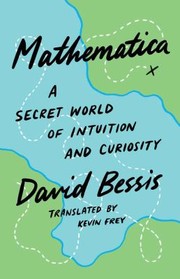
Its thesis fits in a sentence: doing mathematics is not manipulating symbols, it is educating an intuition, and that education stays open to anyone willing not to understand straight away. The book speaks first to those whom school convinced they had no gift for it. I recommend it with a reservation: it is more convincing on the diagnosis than on the method, and the practical half needs completing elsewhere.

One number, and a whole book. It is the best demonstration of what a constraint is worth: by refusing to change subject, the author crosses Greek geometry, the computation of decimals, tests for randomness and the history of machines. For a trade that produces figures the reminder is useful: a number has a history, and knowing it changes what you make it say.
None of these books teaches you to do mathematics; that is not their purpose, and taking them for it would end in disappointment. Nor do I cite the treatises I actually worked through, because an analysis course is not something to recommend: it is chosen according to what you have to prove, and nobody should take it on an engineer’s word. What is above remains reading: it keeps a taste alive, it does not replace an exercise done by hand.